
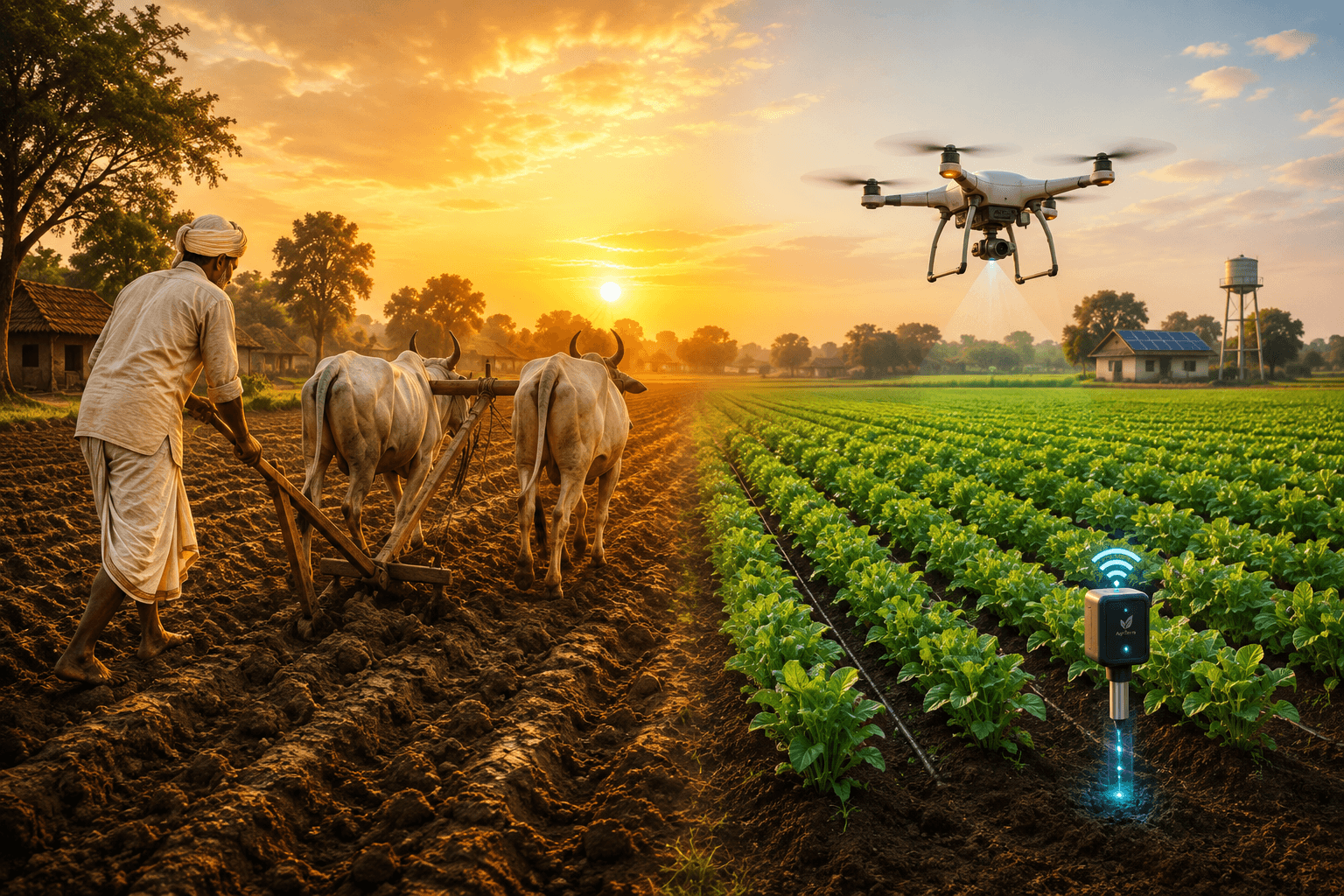
From wooden ploughs and monsoon prayers to AI chatbots and drone-sprayed fields — a look at how Indian agriculture is being reshaped by satellites, sensors, and smart government infrastructure, one smallholder farm at a time.
Introduction#
Picture two farmers separated by seventy years. The first walks behind a pair of bullocks at dawn, guiding a wooden plough through wet soil, reading the sky for signs of rain because that's the only forecast he has. The second stands at the edge of a very similar field, but she's looking at her phone — a pest alert has just come in from an AI system, in her own language, telling her exactly what's attacking her cotton crop and what to do about it before sunset.
That's the distance Indian agriculture has travelled. Not in miles, but in information, tools, and possibility. And the journey from bullock carts to artificial intelligence is really the story of India itself — a country trying to feed 1.4 billion people while lifting the people who grow that food out of uncertainty.
The Bullock Cart Era: Farming by Faith and Muscle#
For most of India's history, farming was a physically demanding, deeply uncertain occupation. Ploughing was done with wooden implements pulled by bullocks. Sowing, weeding, and harvesting were manual, labour-intensive tasks passed down through generations. Irrigation depended almost entirely on the monsoon — a single delayed or failed rainfall could mean the difference between a harvest and a famine.
There was no way to know soil health scientifically, no early warning for pests, and no real access to market prices beyond what the local trader chose to offer. Farmers operated on inherited wisdom and hope. Productivity was low, and risk was extremely high — a fact reflected in the food shortages India faced through the mid-20th century.

The Green Revolution: India's First Big Leap#
The 1960s changed everything. Faced with the real threat of famine, India adopted high-yielding variety (HYV) seeds, chemical fertilizers, pesticides, and expanded irrigation infrastructure — the package of reforms now remembered as the Green Revolution. Tractors and mechanized threshers began replacing bullocks in the more prosperous farming belts of Punjab and Haryana.
The results were dramatic: India moved from a food-deficit nation to a food-surplus one within a couple of decades. But the Green Revolution had a geographic bias — it transformed irrigated, well-resourced regions far more than the rain-fed, smallholder farms that make up most of the country. That imbalance is part of what today's technology wave is trying to correct.
Quick Reference: Green Revolution (1960s–70s) → HYV seeds + chemical fertilizers + irrigation expansion → India shifted from food-deficit to food-surplus, but benefits were concentrated mainly in Punjab, Haryana, and western UP.
The Digital Turn: Phones Before Farms Went Smart#
The next shift didn't happen on the farm at first — it happened in farmers' pockets. Cheap smartphones and affordable rural internet, combined with government digitization drives, gave farmers direct access to weather updates, mandi (market) prices, and basic advisories for the first time, cutting out layers of middlemen and guesswork. This was the quiet infrastructure-building phase — less visible than tractors or drones, but essential groundwork for everything that followed.
Today: The Age of AI and Precision Farming#
This is where the story gets genuinely exciting. India now has close to 126 million smallholder farmers working an average landholding of just 0.6 hectares — roughly the size of a football pitch. For decades, the sophisticated, data-driven tools available to large commercial farms abroad simply weren't built for a plot that small. AI and precision farming are starting to change that arithmetic.
Government-backed digital infrastructure is the backbone of this shift. The Digital Agriculture Mission has built AgriStack — a system of geo-referenced village maps, crop registries, and farmer databases — with more than 8 crore Farmer IDs generated so far, linking farmers directly to crop insurance, credit, and subsidy schemes. AgriStack Sitting on top of this is the Krishi Decision Support System, which fuses satellite imagery, soil health data, weather analytics, and GIS mapping into farm-level advisories.
AI is talking to farmers directly. Kisan e-Mitra, a voice-based AI chatbot available in 11 regional languages, has answered over 95 lakh farmer queries about schemes like PM-KISAN, handling more than 20,000 questions a day. The Union Budget 2026-27 went a step further, proposing Bharat-VISTAAR — a multilingual AI tool designed to knit together AgriStack and ICAR's agricultural knowledge base into one accessible system. India has also built its own agricultural large language model, "Agri Param," under the BharatGen initiative. PM-KISAN
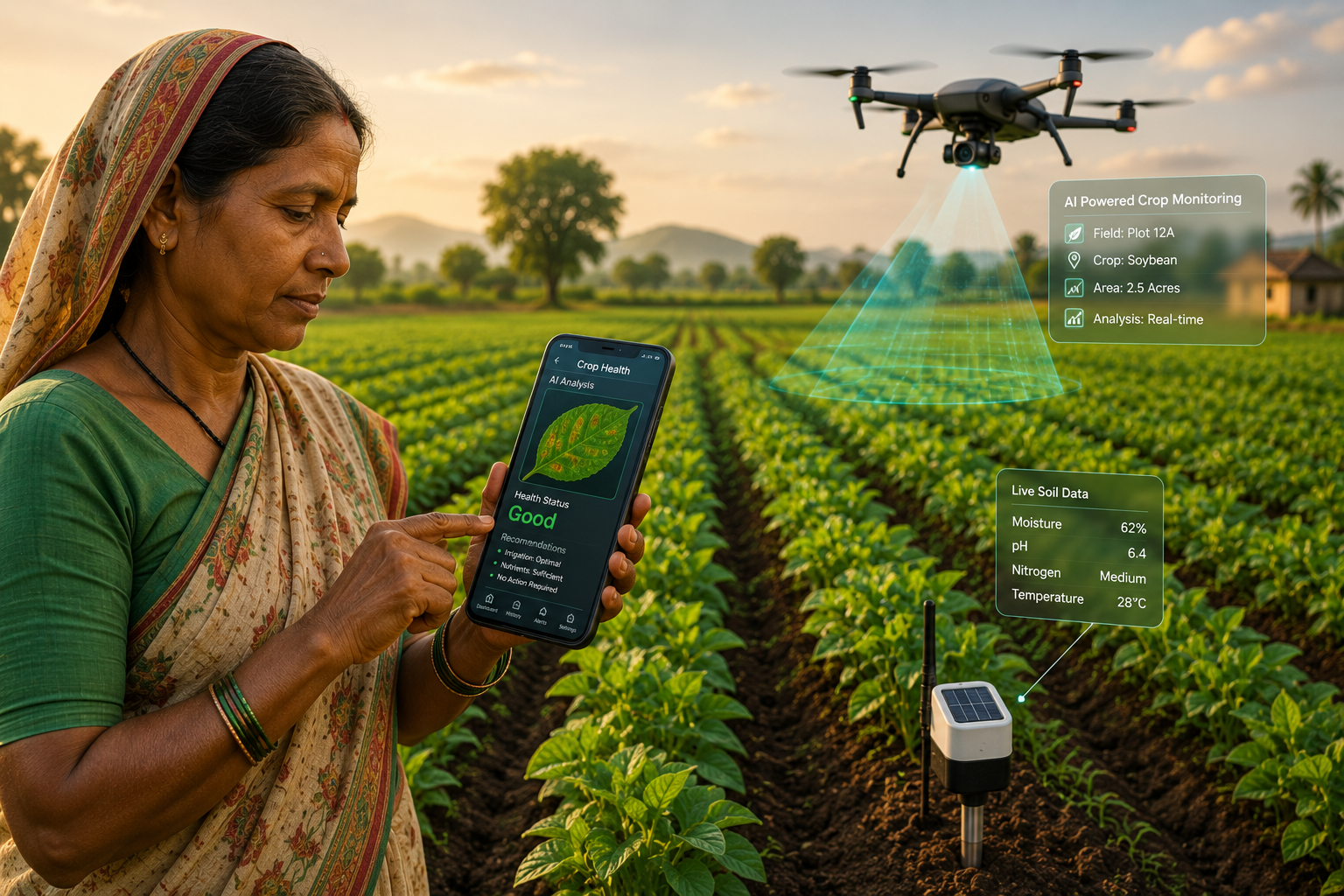
Pests and disease no longer wait for word of mouth. The National Pest Surveillance System uses AI and machine learning to detect outbreaks across 65 crops and more than 400 pest categories, with over 10,000 extension workers using it to catch infestations early — often just from a photo uploaded by a farmer.
Tip: Farmers can check eligibility for precision-farming equipment subsidies and Farmer ID registration through their nearest Krishi Vigyan Kendra (KVK) or the PM-KISAN/AgriStack portal.
Drones have arrived, and women are leading it. The Namo Drone Didi scheme, backed by an outlay of over ₹1,200 crore, is training women's self-help groups to operate drones for spraying and crop monitoring — turning what was once back-breaking, health-risking manual pesticide spraying into a faster, safer, evenly distributed job done from the air. Namo Drone Didi.
And the money is following the mission. The government has committed roughly ₹6,000 crore to precision farming technologies — AI, IoT, and drones — partly through the Smart Precision Horticulture Programme, with subsidies of up to 70% on precision equipment for eligible farmers. Behind all of it sits the broader ₹10,372-crore India AI Mission, building the sovereign computing power and datasets India's agricultural AI needs to keep developing on home soil.
What This Actually Means for a Farmer#
Strip away the scheme names and budget figures, and the real story is simpler: a farmer today can point a phone camera at a diseased leaf and get an answer in minutes instead of waiting for the next visit to a Krishi Vigyan Kendra. Satellite data can estimate standing crop yield accurately enough to support faster insurance claims and loan approvals, rather than a manual field survey that might take weeks. Drip irrigation and drone-based spraying cut water and pesticide use, which means lower costs and less environmental damage. Weather advisories, once vague radio bulletins, are now hyper-local and timed to the day's decisions — whether to irrigate, whether to spray, whether to harvest before the next spell of rain.
None of this replaces the farmer's knowledge — it supplements it with information that used to be available only to large, well-resourced agribusinesses.
The Road Ahead Isn't Without Bumps#
It would be dishonest to present this as a smooth story. India's agricultural AI push still faces real friction. Landholdings remain fragmented, which makes uniform rollout of expensive sensors and equipment difficult. Digital literacy and reliable internet access are still inconsistent in India's more remote and hilly regions. Multiple, overlapping government schemes sometimes create confusion rather than clarity for the very farmers they're meant to help.
Caution: As farmer data is centralized under AgriStack, experts have flagged open questions around data privacy, consent, and who can access this information. This is worth watching as adoption scales.
The good news is that the direction of travel is clear, and it's increasingly inclusive by design — built for smartphones, not desktops; for regional languages, not just English or Hindi; and for the 0.6-hectare farm, not just the large estate.

Conclusion: A Journey Still in Motion#
From a farmer reading the sky to a farmer reading a satellite advisory, Indian agriculture's transformation reflects a larger national ambition — sometimes framed around the goal of a "Viksit Bharat" (developed India) by 2047. Some officials have gone as far as calling even a modest productivity gain across hundreds of millions of smallholder farmers one of the single largest poverty-reduction opportunities of this century.
The bullock cart hasn't disappeared from Indian fields — it still has a place in many smaller and remote farms. But increasingly, it now shares that field with a drone overhead, a soil sensor in the ground, and an AI advisory on a farmer's phone. That coexistence, more than any single technology, is the real story of Indian agriculture's evolution: not a replacement of the old with the new, but a slow, uneven, and hopeful layering of intelligence on top of generations of hard-won experience.

CSwithBS Admin
"CSwithBS Admin is a contributor at CSwithBS, exploring the intersection of modern technology, scientific discovery, and human philosophy."