

Junior developer jobs are down nearly 20%. Overall developer employment just hit an all-time high. Both are true. Here's what the 2026 data actually shows about AI's impact on coding — and why the developers who survive this shift won't be the ones who type the fastest.
The Headline Everyone's Arguing About#
Ninety percent of a codebase, written not by a person, but by a machine that never sleeps, never complains, and never asks for a raise. That's not a hypothetical anymore — it's the reality inside some of the biggest tech companies on earth in 2026.
Microsoft CEO Satya Nadella and Google CEO Sundar Pichai have both said that roughly a quarter of their companies' code is now AI-generated. GitHub Copilot and similar tools now generate 40–60% of code in typical projects, with acceptance rates above 80% for straightforward tasks.
So is traditional programming dead? Depends who you ask — and depends which developer you ask.
The short answer: No, coding isn't disappearing. But the job of "someone who types code line-by-line all day" is disappearing fast. What's replacing it is stranger, higher-stakes, and — for the developers who adapt — considerably more lucrative.
The Data Is Sending Two Completely Different Signals#
Here's where it gets genuinely weird. Two credible studies, released around the same time, tell almost opposite stories.
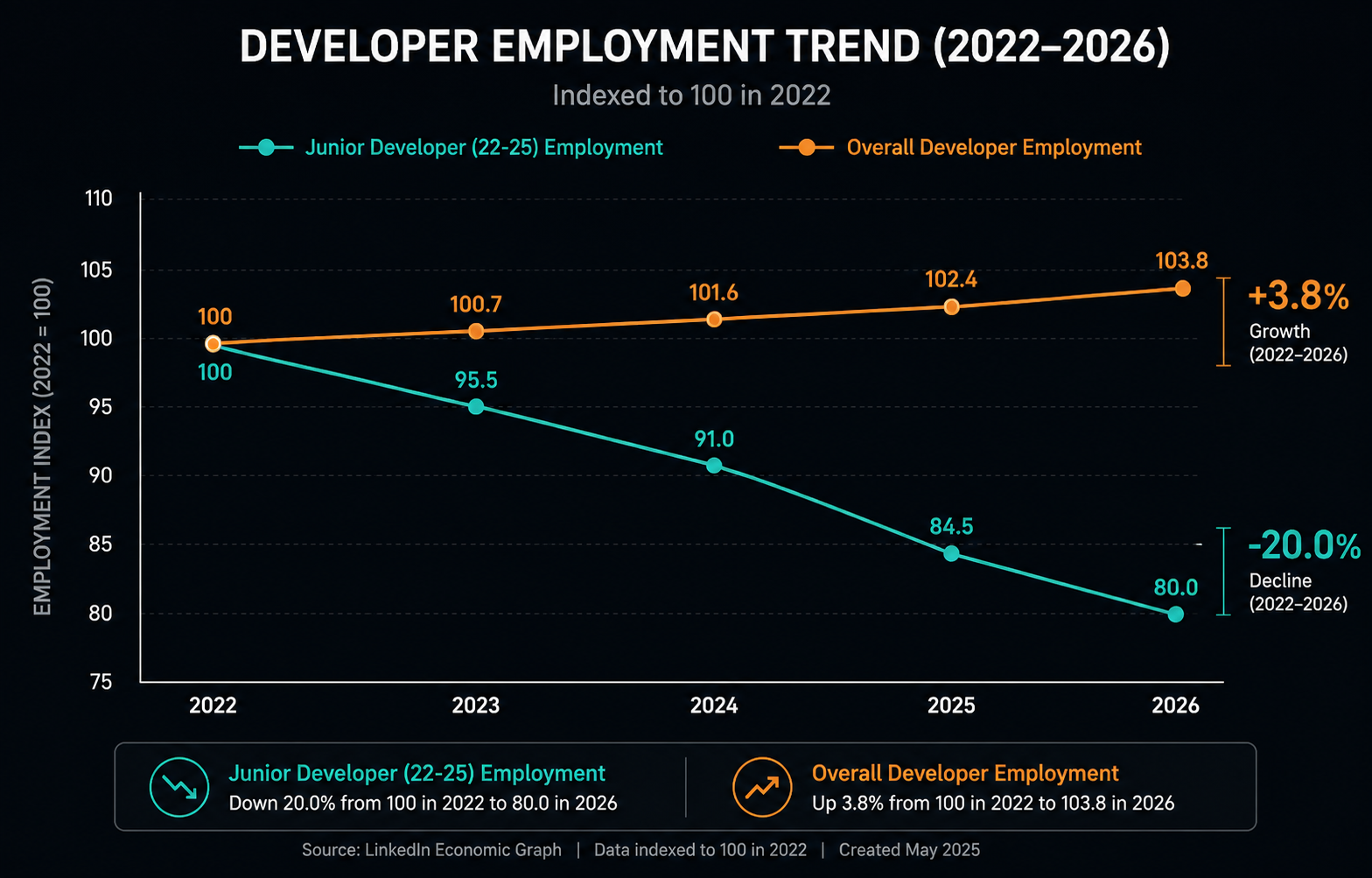
Signal 1 — Something is dying. A Stanford University study found that employment among software developers aged 22 to 25 fell nearly 20% between 2022 and 2025 — a period that lines up almost exactly with the mainstream rise of AI coding tools.
Signal 2 — Something is thriving. The U.S. Bureau of Labor Statistics reported that overall software developer employment actually grew 3.8% in 2025, adding roughly 72,000 net new jobs. Global developer employment hit an all-time high of 28.7 million, according to Evans Data Corporation.
Don't read this as "AI isn't affecting jobs." It absolutely is — it's just not affecting them evenly. Entry-level, "translate a spec into code" roles are shrinking. Senior, judgment-heavy roles are growing. If your job description could be replaced by a well-written prompt, you're in the shrinking half.
The real explanation lives in the job postings themselves. Postings requiring experience with AI coding tools jumped 340% between January 2025 and January 2026. Meanwhile, postings for pure implementation roles — jobs that exist only to turn a spec into working code — fell 17% in the same window.
It's not fewer developer jobs. It's a completely different shape of developer job.
What Developers Actually Do All Day Now#
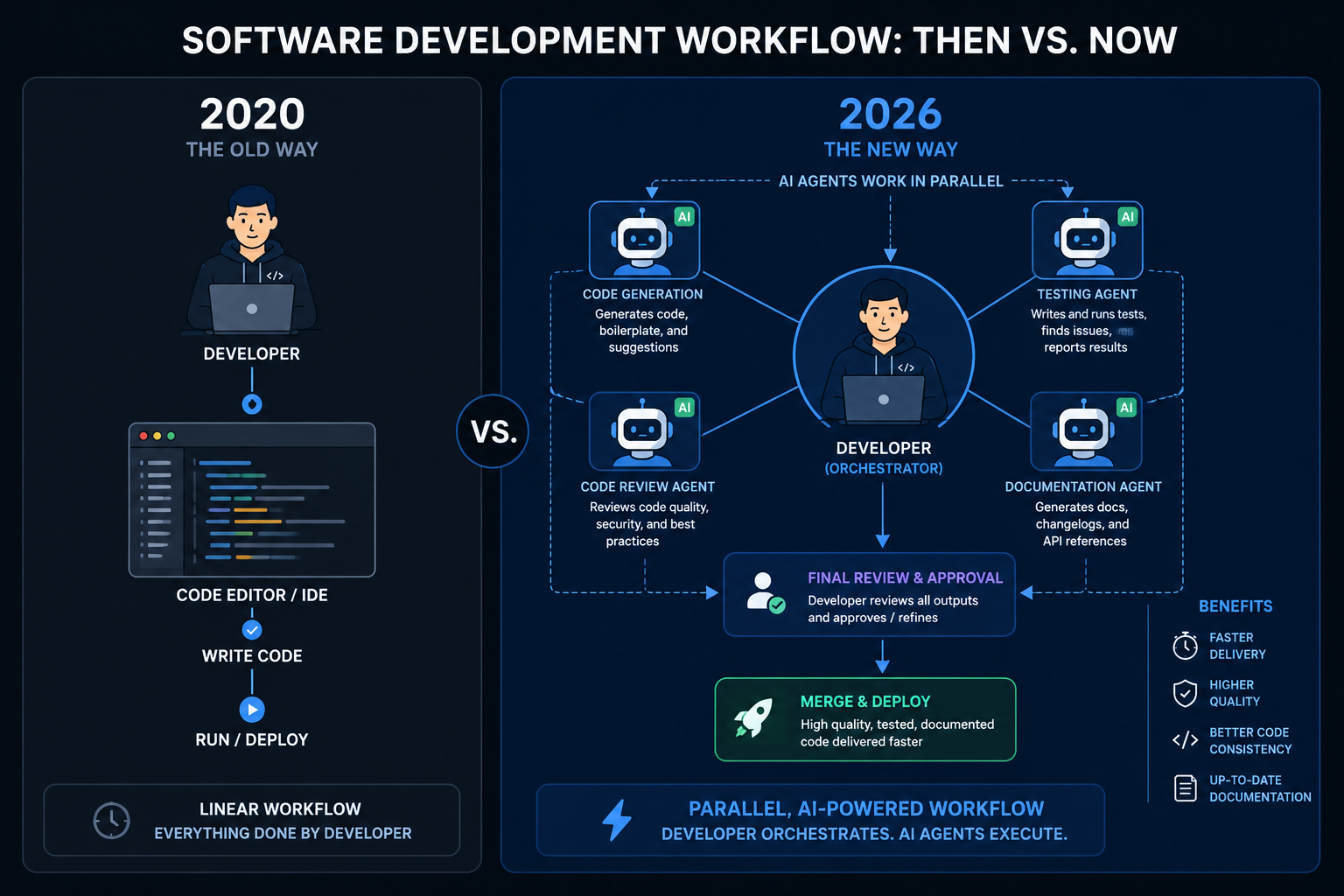
Five or ten years ago, a developer wrote nearly every line of code by hand. Today, at companies like Intuit, engineers spend far less time on repetitive, boilerplate coding and much more time on system design, edge cases, and the kind of ambiguous business problems AI can't independently reason through — like automatically categorizing bank transactions or designing a payment reminder flow that doesn't annoy customers.
The job has shifted from writer to supervisor and editor.
How to think about it: You're no longer the person laying every brick. You're the site foreman — reviewing the AI's work, catching structural problems before they become expensive, and making the calls the machine isn't equipped to make.
One of the clearest examples of this shift at scale: Amazon's internal deployment of AI coding tools saved an estimated 4,500 developer-years of effort and $260 million on a single large-scale migration project. That's not incremental productivity — that's an entirely different operating model for how software gets built.
And the tools themselves are consolidating fast. Claude Code, released in May 2025, became the most-used AI coding tool within just eight months, overtaking both GitHub Copilot and Cursor — a sign of how quickly the tooling landscape is still shifting under developers' feet.
The New Job Titles Nobody Had Two Years Ago#
If you want proof the role is transforming rather than vanishing, look at what companies are actually hiring for.
"AI Integration Engineer" is now the fastest-growing developer job title on Stack Overflow's platform, with a 156% year-over-year increase in postings. This wasn't a real job category in most companies as recently as 2023.
Pay is diverging sharply based on AI fluency too. AI-savvy developers are commanding meaningfully higher salaries than peers doing traditional implementation work — the market is pricing in the ability to direct and evaluate AI systems as a distinct, premium skill.
The opportunity, if you're early-career: The developers winning right now aren't necessarily the best "pure coders" — they're the ones who combine solid fundamentals (architecture, systems thinking, debugging instinct) with fluency in directing AI tools. That combination is currently in short supply and high demand.
Other data backs this up: 82% of developers now use AI tools for code generation as part of their regular workflow, and Gartner's 2026 analysis found that AI-powered code review catches 65% more issues than manual review alone. AI isn't just writing code anymore — it's increasingly the safety net catching the mistakes humans and other AI make.
Before You Get Too Excited: The Warning Nobody's Headlining#
Here's the part the productivity headlines tend to skip.
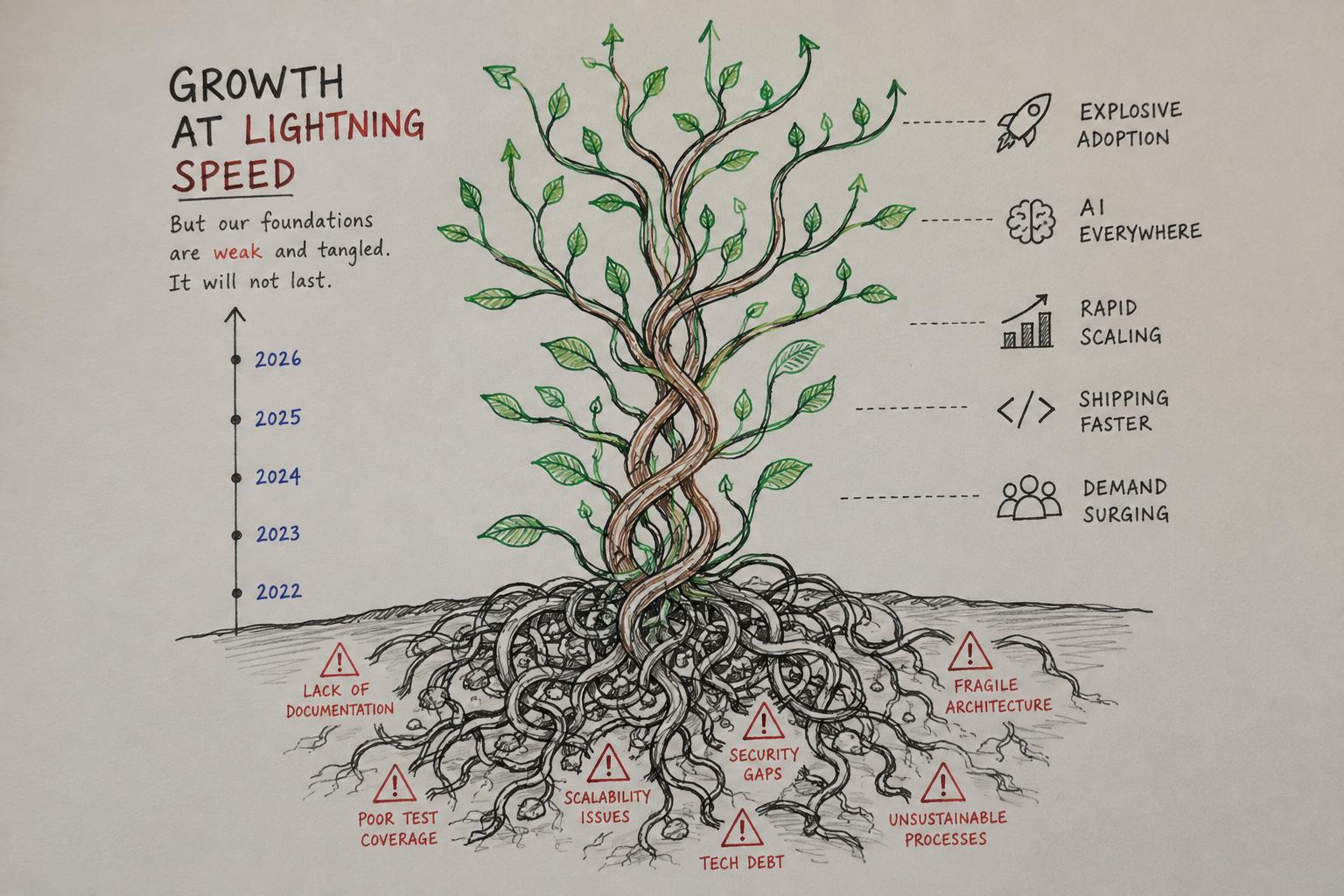
AI-assisted development often produces a 20–30% increase in throughput — but that speed is a double-edged sword. Without the right guardrails, higher throughput lets architectural drift accumulate faster, meaning codebases can quietly become messier and harder to maintain, even as they ship faster.
The real risk isn't unemployment — it's technical debt at machine speed. A team that lets AI generate code without strong review processes, documented architecture decisions, and clear ownership isn't moving fast. It's borrowing against next year's stability to pay for this quarter's velocity. The teams getting burned aren't the slow ones — they're the reckless fast ones.
It's genuinely unclear, even to researchers studying this closely, whether AI coding tools are net giving developers an unprecedented productivity boost, or quietly setting up a wave of poorly designed, hard-to-maintain software that will cause serious problems down the line. Both things appear to be true simultaneously, depending on how disciplined the team using the tools actually is.
So — Is This the Assembly Language Moment All Over Again?#
There's a useful historical parallel here. Did the shift from assembly language to high-level programming languages like C++ eliminate programming jobs? No. It eliminated certain kinds of tedious, low-level work — and created entirely new categories of development that didn't exist before.
AI coding tools appear to be following the exact same pattern. The difference is speed: what took decades with programming language evolution is happening in a matter of two to three years with AI.
The pattern repeats every technology cycle: New tool removes the tedious 80% → panic that the profession is over → the tedious 80% actually gets removed → new, higher-value work fills the vacuum → demand for skilled people goes up, not down. Compilers didn't kill programmers. IDEs didn't kill programmers. Frameworks didn't kill programmers. AI is (so far) rhyming with all of them.
The Bottom Line#
Traditional programming — the version where a developer's core value was typing correct syntax quickly — is genuinely fading. That job description is dying, and the data on 22-to-25-year-old employment shows the pain is real, not hypothetical.
But "programming" as a discipline — defining problems, architecting systems, making judgment calls about tradeoffs, catching what a machine gets wrong — isn't dying. It's becoming more valuable, not less. The demand for people who understand both the fundamentals of software and how to direct AI systems is outpacing the supply, and the salary data already proves it.
The question worth asking isn't "will AI take my coding job." It's: "Am I still the person who just writes the code, or have I become the person who knows whether the code is right?"
Only one of those two people has a future in this industry.
If you're a developer reading this: Start treating AI-fluency as seriously as you'd treat learning a new language or framework. Learn to review AI output critically, not just accept it. Learn to write specs and prompts precisely. The gap between "developer" and "AI-integration engineer" is closing, and it's closing from the demand side, not the supply side.

Sources#
[1] Stanford University study on developer employment trends, cited via MIT Technology Review — technologyreview.com
[2] U.S. Bureau of Labor Statistics developer employment data, and Evans Data Corporation global developer figures — cited via Tech Insider
What's your take — is your role shifting toward supervision, or are you still writing most of your code by hand? Drop a comment below.

Amarnath Bera
"Developer by trade, translator of tech chaos by habit. Amarnath writes about where software is headed — and what it means for the people still building it."